
Platform
Issuance profiles and key usages
CA and endpoint extended key usage restrictions.
Two lists control certificate usage:
- the issuing CA's issuance profile;
- the endpoint's permitted extended key usages, which must be a subset of the CA profile.
The policy form disables usages that the CA does not permit.
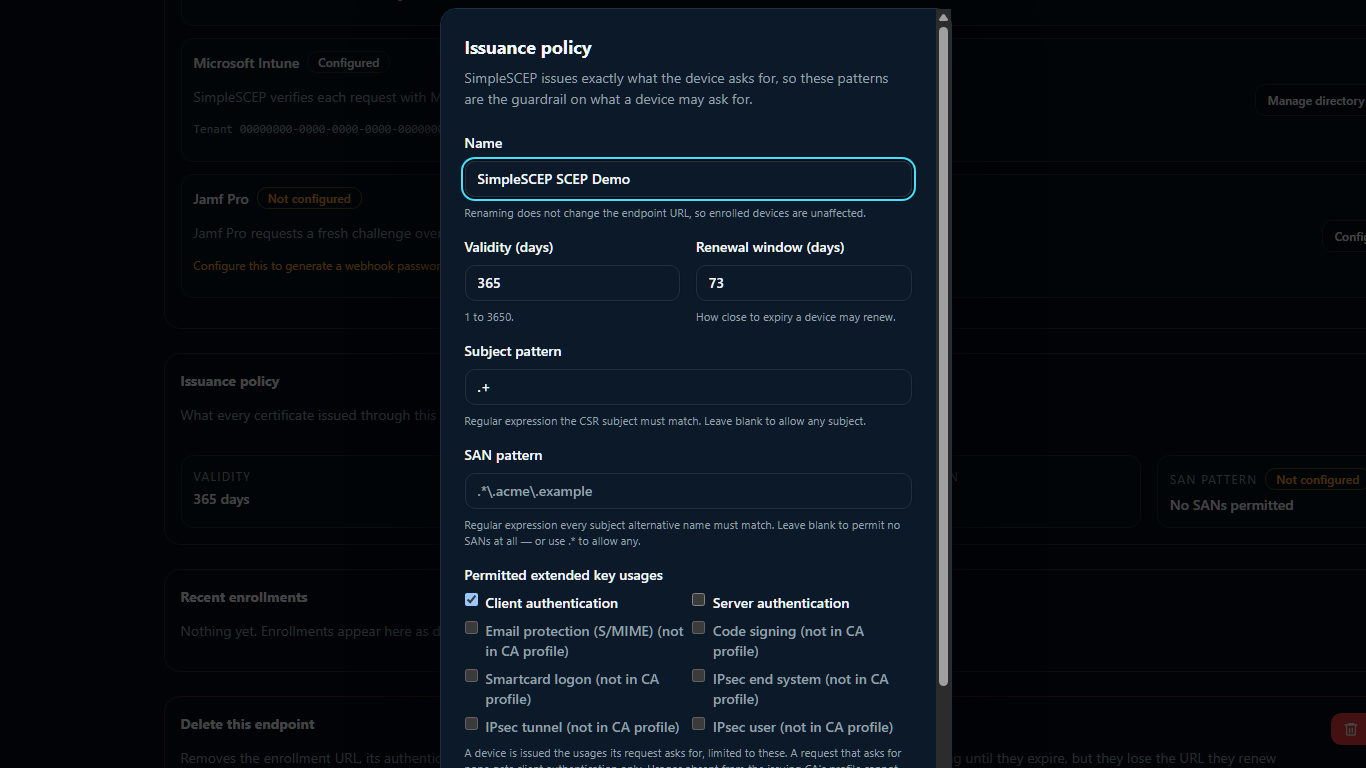
Usage rules
- A request for a permitted subset receives that subset.
- A request with no usages receives client authentication only. It is rejected if the endpoint does not permit client authentication.
- A request for an unpermitted usage is rejected and recorded under Recent enrollments.
Supported usages
| Usage | Typical use |
|---|---|
| Client authentication | 802.1X, Wi-Fi, VPN, mutual TLS |
| Server authentication | Internal TLS listeners |
| Email protection (S/MIME) | Signing and encrypting mail |
| Code signing | Signed binaries and scripts |
| Smartcard logon | Windows domain logon |
| IPsec end system, IPsec tunnel, IPsec user | IPsec and IKE deployments |
Custom dotted OIDs can be added to an issuing CA's own profile for usages not on this list.
Two usages are always excluded:
- OCSP signing, which would let the certificate act as a delegated responder.
anyExtendedKeyUsage(2.5.29.37.0).
Time stamping and MAC address usages are excluded from endpoints as having no enrollment meaning. Issue either from the Certificates page instead.
Per-enrollment restrictions
A SCEP one-time challenge can further restrict usages for one enrollment.
A pin cannot add usages. Usage order does not matter; SAN order does. See SCEP challenges and secrets.
Key usage bits
Key usage bits depend on purpose and key type:
digitalSignatureis always set — every issuable purpose signs.- Encryption bits are added for client and server authentication, email protection, smartcard logon, and IPsec usages.
- RSA receives
keyEncipherment; EC receiveskeyAgreement. - A custom dotted OID is treated as possibly needing both.
Subject and SAN patterns
Both are regular expressions. They accept or reject a CSR without modifying it. Blank patterns allow any value.
The rendered CSR subject encodes emailAddress as an OID (1.2.840.113549.1.9.1=#…). Anchor subject patterns on CN; match email addresses with the SAN pattern.